POPULAR PAGES

Weather and forecast for New Bedford and the Buzzards Bay watershed.

Septic System Test Center Results
Information on the Bouchard B120 oil spill.

QUIZ: 3 out of 18 specialty plates in Massachusetts fund environmental projects. Do you know which they are?

Wind Turbines in Buzzards Bay
Other Buzzards Bay Organizations

Website of the citizen's group, The Coalition for Buzzards Bay.

Info on the municipal official group, the Buzzards Bay Action Committee.
News, Features, and Information for Buzzards Bay and the NEP
Availability of 2013 Buzzards Bay Municipal Grant Funding
This spring, the Buzzards Bay NEP, through the Massachusetts Executive Office of Energy and Environmental Affairs’ (EEA) Office of Coastal Zone Management (CZM) is making available $121,600 in federal funds as part of the Buzzards Bay municipal grant program. Funded by the U.S. Environmental Protection Agency (EPA) and administered by our program, this grant program aids towns in testing and treating stormwater discharges, protecting wetlands and wildlife habitat, improving water supplies and safeguarding open spaces. The Buzzards Bay NEP posted a Request for Responses (RFR) as part of our municipal grant program at the Commonwealth of Massachusetts' Comm-Pass.com system. Applications are due by 4 PM, Thursday, June 27, 2013. Go to our Funding page for more information.Buzzards Bay Action Committee hosts Earth Day Expo on Saturday, April 20, 2013
The BBAC invites area residents to come to the Fairhaven Senior Center on Rt. 6 in Fairhaven on Saturday, April 20, 2013 to celebrate Earth Day. Events are scheduled 10 a.m.— 4 p.m. and include a bird walk, lectures and music. Go to the BBAC website for the full program and more information.Buzzards Bay NEP seeking Stormwater Engineering Design Services
In partnership with the Town of Westport, and as part of our municipal grant program, the Buzzards Bay NEP is seeking engineering services to assist the Town of Westport develop stormwater treatment designs to reduce stormwater volumes and pollutants contributing to water quality impairments in the East Branch of the Westport River. The RFR was posted April 18, 2013, the bidders' conference is Tuesday, May 7, at 11:00 AM, and proposals are due Thursday, May 30 by 4:00 PM. Go to our stormwater designs procurement page for more information (see link under active RFRs).Buzzards Bay NEP initiating study of salt marsh expansion and migration with sea level rise
The Buzzards Bay National Estuary Program (BBNEP) is evaluating the potential expansion and migration of existing salt marshes, particularly those that are in tidally restricted areas, within the Buzzards Bay watershed. Like our study of the likely expansion of the one-percent ("100-year") floodplain, we are evaluating salt marsh expansion and migration with 1-foot, 2-foot, and 4-foot increases in sea level. The existing floodplain will be extrapolated upward based on the existing upper elevation boundaries of the marsh. Because tidal regimes differ slightly around Buzzards Bay, the real world elevation of the high marsh boundary (in the NAVD88 datum), also varies around the bay slightly. Consequently in this study the 1-foot, 2-foot, and 4-foot increases in sea level are added to elevation of the specific upper boundary of the marsh in that part of Buzzards Bay. Go to the salt marsh migration study page for more information on this new project.Green Seal Environmental Inc. developing stormwater treatment designs for Wareham Main Street.
In partnership with the Town of Wareham’s Community and Economic Development Authority (CEDA), the Buzzards Bay NEP used $20,000 in federal funds to hire Green Seal Environmental Inc. to develop stormwater treatment designs for the Main Street drainage system in the Town of Wareham, MA to reduce stormwater-related pollutants discharging to the Wareham River estuary. Go to our Stormwater Engineering Designs Procurement page for more information.Updated Draft Buzzards Bay Management Plan Distributed for Comment
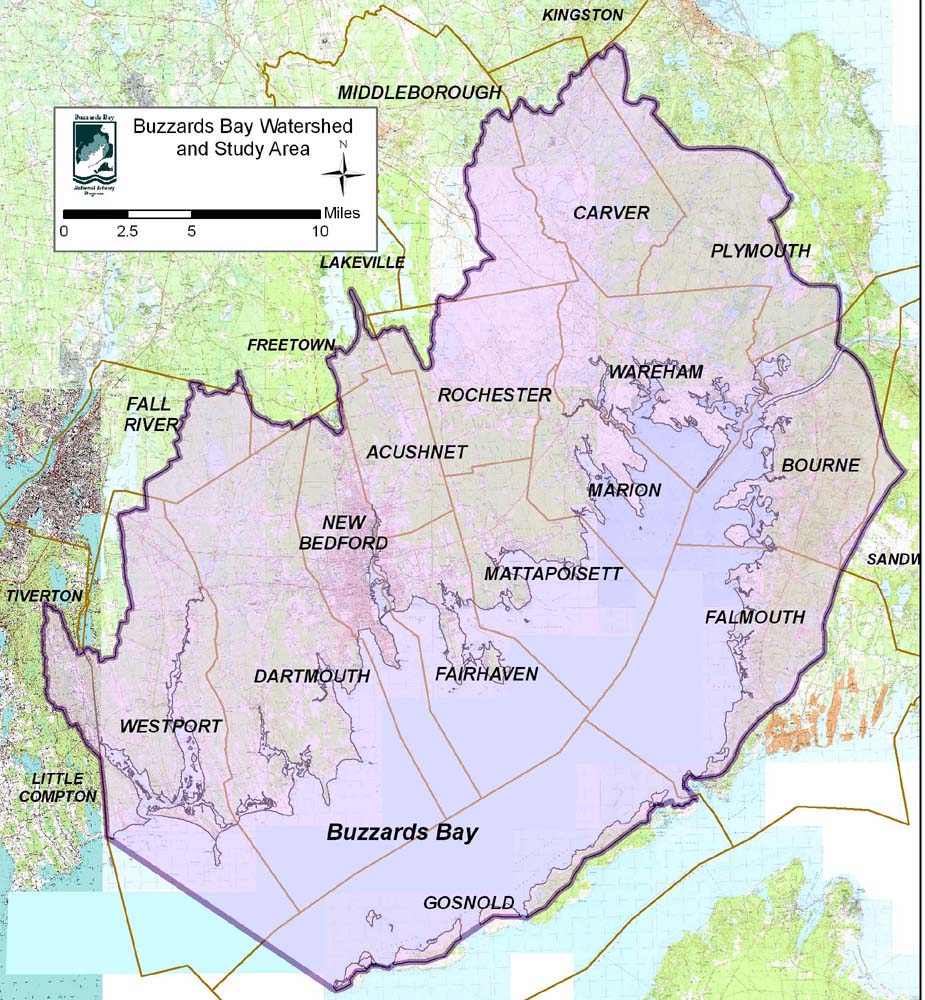
In 1991, the Buzzards Bay National Estuary Program (NEP), a unit of Massachusetts Coastal Zone Management, developed the Buzzards Bay Comprehensive Conservation and Management Plan (CCMP). This landmark document was a blueprint for the forthcoming efforts to protect and restore the water quality and living resources of Buzzards Bay and its surrounding watershed. The CCMP introduced many new concepts to local government including the need to establish watershed limits on the discharge of nitrogen from wastewater (especially septic systems) and other nitrogen sources, the importance of stormwater discharges as a cause of bathing beach and shellfish bed closures, and the recognition that the climate was changing. The Buzzards Bay NEP has now updated the Buzzards Bay CCMP to reflect progress achieved, new problems facing the bay and its surrounding watershed, and the ongoing unresolved problems that remain since the original plan was finalized. This updated Buzzards Bay CCMP includes existing, new, and revised goals that relate to 21 key issues facing the bay and watershed. In each of the 21 "Action Plans," we identify strategies for government, citizens groups, and the public to employ to meet the continuing challenges we face.The updated management plan has been mailed to Buzzards Bay watershed municipalities for comment, and we are also inviting area residents to review and comment upon the document. While the Buzzards Bay CCMP is not a regulatory document, it lays out a vision that we hope will continue to guide municipalities and non-governmental organizations in their ongoing efforts to protect and restore the environment. It will also assist state and federal agencies to direct grants and technical assistance programs, and to help guide the update of policies and regulations to benefit the bay and watershed for years to come. Go to our New CCMP page to read and comment upon the plan.
Buzzards Bay NEP Undertaking Sea Level Rise study
The Buzzards Bay National Estuary Program (BBNEP) and the Massachusetts Office of Coastal Zone Management are evaluating the potential expansion of the existing Federal Emergency Management Agency (FEMA) 100-year floodplain using Flood Insurance Rate Map base flood elevations for Buzzards Bay municipalities. The floodplain will be expanded with 1-foot, 2-foot, and 4-foot scenario increases in sea level. The existing floodplain will be extrapolated upward based on the FIRM base flood elevations. Using a recent assessor's data set, the number of buildings, their assessed values, and municipal structures are being enumerated within these various sea level rise expansion scenarios for each Buzzards Bay municipality. Go to our Flood Zone Expansion with SLR page for more information about the project and to read 6 new draft reports for Buzzards Bay towns.Buzzards Bay NEP Announces $122,000 in Environmental Grants to Five Municipalities
The Buzzards Bay National Estuary Program, part of the Office of Coastal Zone Management, and administered by the Massachusetts Executive Office of Energy and Environmental Affairs, will award grants to five Buzzards Bay watershed municipalities to fund land conservation and infrastructure improvement projects designed to conserve open space and rare species habitat, protect drinking water resources, restore wetlands, study nitrogen discharges to estuaries, and help open shellfish beds. Go to our Funding page for more information about the grants.Information on Hurricane Sandy impacts to Buzzards Bay plus photos from Falmouth
While New York and New Jersey were devastated by Hurricane Sandy, the impacts of the storm to the Buzzards Bay area were relatively minor, both because we were so distant from the eye, and because, with Sandy's persistent easterly winds, Buzzards Bay was on the lee side of Cape Cod, and relatively well protected. Some areas, however, did experience coastal erosion more severe than the damage caused by either Tropical Storm Irene and the 2007 Nor'easter. Among Buzzards Bay watershed communities, the greatest damage occurred on the south facing side of Falmouth (on Vineyard Sound), and on the south coast of Westport. Go to our Hurricane Sandy impacts page for more information about the storms local impacts.Cochlodinium Blooms in Buzzards Bay
The Buzzards Bay NEP, and our partner, the Buzzards Bay Coalition, have received many reports of pronounced blooms of Cochlodinium in Buzzards Bay. Go to our Dinoflagellate Blooms page for information and links.Google Earth Maps of new FEMA flood zones
FEMA has posted new digital flood insurance rate maps (FIRMs) for Buzzards Bay. We have posted important links, as well as a useful Google Earth file we created on our FEMA information page, to help residents better understand areas subject to storm flow. We have also obtained new LIDAR data from FEMA which we used to prepare this 15-foot Marion elevation zone map for the Marion Conservation Commission.Information on past Wind Farm proposals for Buzzards Bay
Looking for information about the South Coast Offshore Wind Project? Read about meetings, and the information we posted about a similar 2002 proposal for Buzzards Bay that explains many of the regulatory and environmental issues that would need to be addressed for siting wind turbines in Buzzards Bay on our Wind Farms page. Have you noticed a windmill to the south as you have crossed the Bourne Bridge? We have a photo of the Massachusetts Maritime Academy wind turbine that began operation in 2006, as well as information on the water turbines proposed for Vineyard Sound.Other Popular Pages and Downloads
1980s Historical Eelgrass GIS Coverage Posted
On our eelgrass page we have posted links to download GIS data showing the distribution of eelgrass mapped in Buzzards Bay during the 1980s. In most of Buzzards Bay, eelgrass reached it post-1930s wasting disease peak abundance in this decade. In the coming weeks we plan on disturbing new GIS coverages, maps, and georeferenced aerial photographs showing eelgrass abundance in the 1940s, 1960s, and 1970s for selected parts of Buzzards Bay.Massachusetts Estuaries Project reports for Buzzards Bay
Reports for West Falmouth Harbor and Phinneys Harbor / Back River complex have been released. Other reports will become available in the coming years. We have provided some support for this effort for selected subwatersheds as described on our Subwatershed Land Use and Nitrogen Loading page.WETLAND LOSS MAPS available for viewing.
We have updated our wetland loss page to include new maps we produced based on DEP's wetland change maps sent to Buzzards Bay municipalities in 2004. Click the link to read more.
Bouchard No. 120 Oil Spill in Buzzards Bay
On April 27, 2003, an oil barge, carrying 4.1 million gallons of No. 6 fuel oil, spilled an estimated 98,000 gallons of oil into Buzzards Bay, the second largest spill in the bay's history. More than 93 miles of coastline were affected, and hundreds of birds killed. Click the link above to see recent cleanup summary reports. Other popular pages and links include our page US Coast Guard: 98,000 gallons best estimate of oil spilled, the New Bedford Standard Times Op Ed article on how the Buzzards Bay NEP helped in this determination, and our Oil Spill Legislation page.
Have you confused us with another Buzzards Bay organization?
In the 1980s, the Buzzards Bay NEP had a "Citizen Advisory Committee" or CAC that was part of the program and was helping with the evaluation of pollution and identification of management options to protect and restore Buzzards Bay. This CAC broke off from the Buzzards Bay NEP and eventually became two independent, not-for-profit organizations. The first organization called itself The Coalition for Buzzards Bay. It was a '501(c)3' educational and outreach a citizen-based group. The second became the Buzzards Bay Action Committee, a non-profit organization composed of municipal officials, that has become more involved with state, local, and federal legislative and regulatory issues. Today, both organizations are on the Buzzards Bay NEP's Steering Committee, and both have adopted as one of their major goals, the implementation of recommendations contained in the Buzzards Bay Comprehensive Conservation and Management Plan.The views or information contained here do not necessarily reflect the views of the Commonwealth of Massachusetts or the US EPA.